The Coffee Career Ladder No Longer Exists
The Coffee Career Ladder No Longer Exists
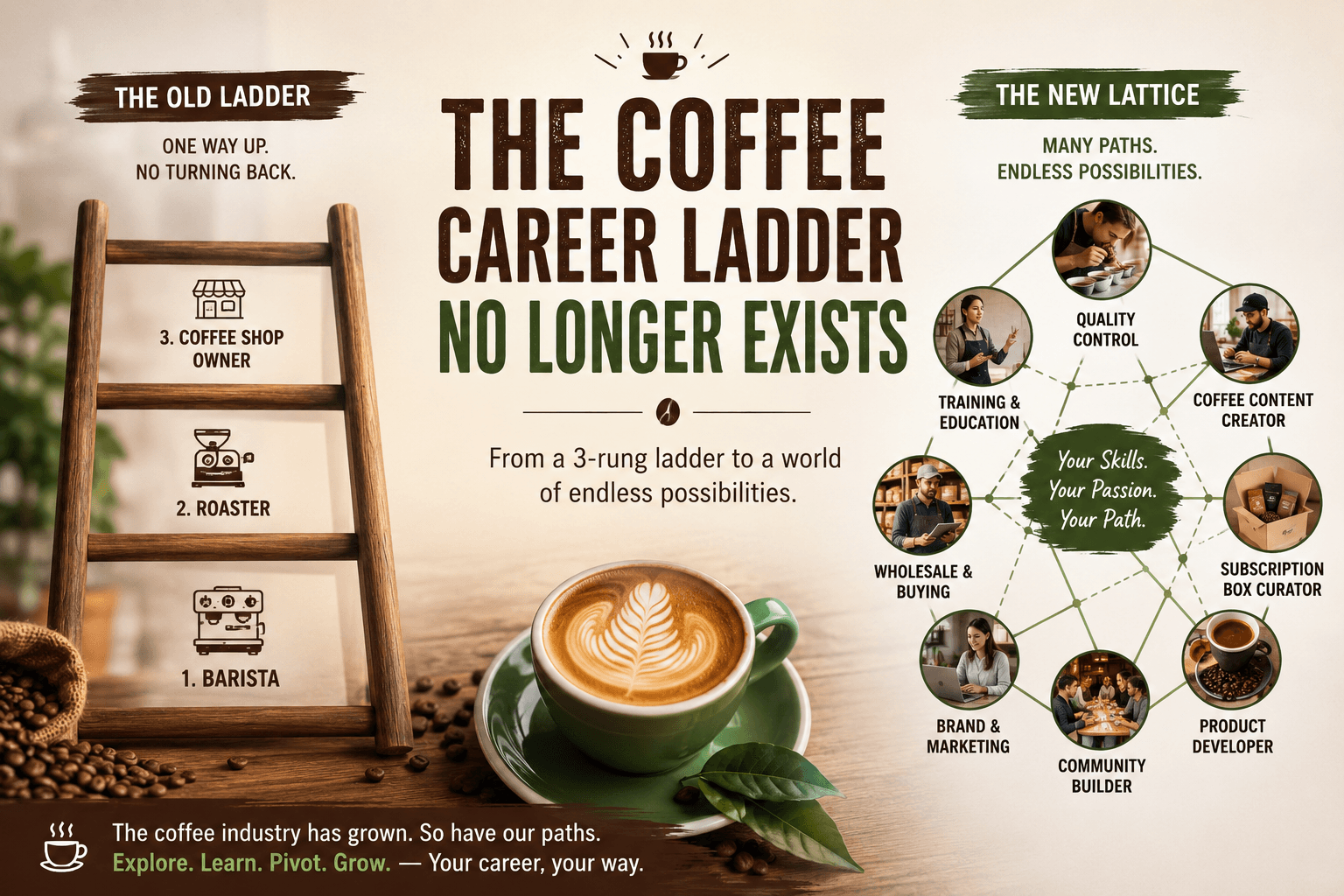
If we ask a person with 15 years in the specialty coffee business about how careers worked back then, they'll probably recount something very closely resembling a career ladder. First, one joined at the bar. If one proved himself good and didn't move out, they went up a rung and worked in roasting.
And if one was really lucky, and a little daring, one would eventually end up opening his/her coffee shop. It was a 3-rung ladder with no turning back. It was straightforward, and everyone saw it clearly, and for quite some time, it didn't differ much.
It has changed.
The old path wasn't given up in the traditional sense; rather, the industry expanded so much that it created many alternative avenues. Think of it as a pergola rather than a ladder, a construction with numerous vertical columns, cross-links and no central roof. A barista now could change direction, go sideways and end with the training, move diagonally to the wholesale department, or simply jump to a new type of work that didn't feature on the radar a decade ago: for instance, becoming a coffee content creator or a subscription-box curator. Each of these routes doesn't offer a second-best roastery job; they are unique paths with their own worth.
To a large extent, this transition is just a matter of the industry getting more mature. In the early years, industries tend to have simple, limited structural designs because there are only a few positions. With the expansion of the specialty coffee scene, the number of stores, roasters, importers, media and brands has exploded, and the variety of job types has grown. A weave of fibers is not possible without enough threads.
Movability of Skills
This was also one of the factors, and a smaller one at that: the base skills learned and applied behind the bar ended up being far more versatile than anyone would have even expected. Training of the palate, feeling of being hospitable, understanding of consistency, staying calm during chaotic situations, none of these are only good or relevant for the roastery. They have their place in quality control, team leadership, brand creation or teaching others about flavors. The traditional channeling of one's ability into becoming a roaster was the only place of realization. But one discovers that there are other equally important parts of the business where those skills would have been applied for years.
The pandemic brought forth rooms that were hitherto undiscovered
Although the network had been slowly coming together for years prior, it was the pandemic that really pushed the changes. Due to stores either shutting down or being allowed to operate only at a low capacity, quite a few coffee experts were compelled to ask themselves very quickly what kind of work, other than coffee, they could be useful at. There were those who got engaged in the production of e-learning resources. Others began to form communities and build brand followings via social networks. Some people, in their search to become self-sufficient during the crisis, began making their own items. Things that one might normally think of as very conservative have taken root and flourished digitally in less than two years, and not all of them turned back when the shops reopened.
Digital platforms have remained. Besides that, it's also about the transformation of the role of mentorship, hiring and even the way baristas should plan their own careers in the coffee industry. A ladder metaphor assumes that there is a standard correct next step, and if you don't take it, you have already given up. Then again, lattice suggests something more encouraging: that there are several valid paths to take your career, and the one that is right for you really depends on your personality, not your hierarchical level.
Shop owners and roasters, on one hand, will now need to engage in career conversations with their staff that are much more detailed and creative than just “Are you thinking about roasting?”
Baristas, then again, will be encouraged to design a career that is in harmony with their strengths instead of going with whatever path is easiest or most visible at the time.
With the ladder, coffee careers used to be seen as pretty much the same. With the lattice, they become varied and interesting. And I think that trade-off is a win.

